 During his research period of The Heroes Project designer Abhishek Choudhury came
across a lot of folktales which spoke of a trickster deity called /Kaggen in
their stories. In folklore of the /Xam people, /Kaggen is seen as the most
important deity as a trickster and a creator. /Kaggen is said to be a
shape-shifting bushman shaman and often represented as a mantis. The bushman
shamans often spoke about physical transformations and shape-shifting in the
spirit realm. /Kaggen, the mantis, is said to be the one who created the moon
and also the first Eland and other antelopes. In Phase 1, he did an analysis into
the character of /Kaggen in an effort to understand the natural and cultural
forces that could have moulded this character. More on the character design process.
Showing posts with label LED. Show all posts
Showing posts with label LED. Show all posts
Thursday, June 19, 2014
The Heroes Project: Character Design - Designing the Mantis
During his research period of The Heroes Project designer Abhishek Choudhury came
across a lot of folktales which spoke of a trickster deity called /Kaggen in
their stories. In folklore of the /Xam people, /Kaggen is seen as the most
important deity as a trickster and a creator. /Kaggen is said to be a
shape-shifting bushman shaman and often represented as a mantis. The bushman
shamans often spoke about physical transformations and shape-shifting in the
spirit realm. /Kaggen, the mantis, is said to be the one who created the moon
and also the first Eland and other antelopes. In Phase 1, he did an analysis into
the character of /Kaggen in an effort to understand the natural and cultural
forces that could have moulded this character. More on the character design process.

Friday, June 13, 2014
The Heroes Project: Graphic Narrative
 Natural Justice's Heroes Project is an initiative started to revive the
mythology and folklore of the Khoi-san as a spiritual and cultural relief to
face their present day socio-political struggles. The Heroes Project phase 1 of
the project started in July 2013 which led to the creation of a workshop model
for teenagers aged between 13-15.
The workshop combined elements of theatre,
dance, shadow puppetry and mythology to create a space for sharing personal
stories and experiences. The idea for such a space came from the ancient
story-telling culture of the Khoi-san, which is almost extinct. The space was
intended to be a bridge between the reality of the personal stories to the
mythology/ folklore of the Khoi-San. Read more about the Project.
Thursday, July 4, 2013
LED Lab interviewed for Tactical Technology Collective

Arpitha Kodiveri of Natural Justice was featured in the micro magazine that was published as a part of the evidence and influence conference organized by the Tactical Technology Collective in June, 2013. The magazine features interviews of environmental activists from across the world who have attempted to use creative techniques for intervention. The interview highlights the role of design in the communication of law, an approach which is being experimented with at the Law, Environment and Design Lab. The LED Lab is an innovative space set up collaboratively between the Srishti School of Art, Technology and Design and Natural Justice. This interview features its pioneering efforts to create a board game on a progressive law in India called the Forest Rights Act, 2006 as well as a paralegal toolkit that uses puppet theater to speak about this law and its importance. The interview is available for viewing here.
Thursday, February 21, 2013
Second Meeting of the ARI-BCP
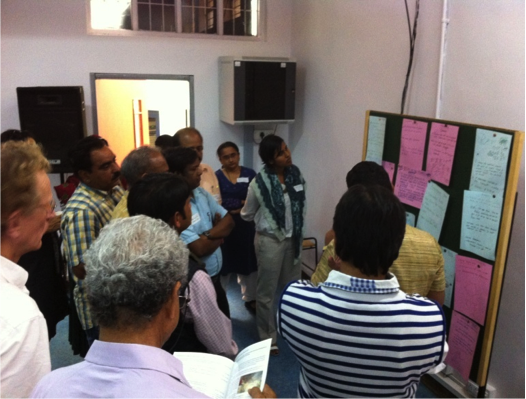
Natural Justice and the Law, Environment and Design (LED) Lab organised the second meeting of the Asia Regional Initiative on Biocultural Community Protocols (ARI-BCP) at the Srishti School of Art, Design and Technology in Bangalore from 18-20 February, 2013. The meeting was attended by ARI-BCP participants from India, Sri Lanka and Nepal working to support tribal rights, fishing community rights, the rights of communities affected by extractive industries, traditional healers’ rights and farmers’ rights. The meeting was supported by The Christensen Fund and the Ford Foundation.
Participants primarily discussed how BCPs can be used in securing the rights of indigenous communities. They also discussed how domestic legislation can be used in preparing BCPs and how the experiences of BCPs can be shared across larger networks.
Thursday, February 7, 2013
LED Lab Mapping in Sariska Tiger Reserve

The team from the Law, Environment and Design (LED) Lab, a new partnership between Natural Justice and the Srishti School of Art, Design and Technology, visited three villages in the core area of the Sariska Tiger Reserve to begin a resource mapping process with the Gujjar community. The team was accompanied by KRAPAVIS, a local NGO. The team worked with the community on a cognitive mapping exercise where different groups gathered to fill the chart paper with their understanding of the space they lived in. These cognitive maps became an effective tool to document the injustices caused by the denial of their rights to access the forest after its declaration as a tiger reserve. The LED Lab team conducted meetings with the Gram Sabha in each village to understand the status of implementation of the Forest Rights Act, 2006 and through this determined that knowledge of the Act was limited. The design students accordingly decided to develop a graphic novel that chronicles the different provisions of the Act and describes its interaction with potentially conflicting laws like the Wildlife Protection Act, 1972. The team also visited relocated villages where communities are still struggling with the dramatic transition and heard of the lack of community consultation through the relocation process. The LED team will now work towards creating a simple relocation chart that will detail options available along with experiences and challenges faced by other villages.
Wednesday, January 9, 2013
LED Lab Projects Presented
 From 7-8 January 2013, the Law, Environment and Design (LED) Lab hosted presentations on projects
being offered to the design students of the Srishti School of Art, Design and
Technology for the coming semester. Around 40 students participated in the
presentations from diverse backgrounds ranging from filmmakers to textile
designers. The students will be working on two projects. One will be with the Gujjar
community in Alwar, living in the Sariska Tiger reserve. The other will be with the Maldhari camel
breeders in Kuttchh.
The students will embark on their first field visit from 27 January - 3 February where they will work with community members on a
participatory resource mapping process with the objective of presenting it as
legal evidence and as a tool for future negotiations with external stakeholders.
The students will also be looking at other outcomes from this
experience. At the presentations, some proposed making a documentary on the entire experience. Others
suggested the creation of cognitive maps to breakdown the rights and
claims over the space that they occupy. The LED Lab will commence project work on
11 January with an immersion class introducing the students to the local
context. The class will be taught by Kabir Bavikatte and Arpitha Kodiveri of
Natural Justice and Deepta Sateesh from Srishti.
More information on the
projects and the presentation can be found here.
Wednesday, December 12, 2012
Law, Environment and Design Workshop - Bangalore
 Natural Justice and the Srishti School of Art, Design and Technology co-hosted a workshop entitled “Engendering Dialogue among Law, Environment and Design” at Srishti's campus in Bangalore, India on 7 December, 2012. The workshop sought to share the visions of participants, discuss ways of working together, and explore possible intersections between law, environment and design. The workshop also saw the launch of the website of Natural Justice and Srishti’s exciting new joint project, the Law, Environment and Design (LED) Lab (opening January, 2013). Representatives from the Global Environments Summer Academy, the International Centre for Trade and Sustainable Development and the Ashoka Trust for Research in Ecology and the Environment also participated in the workshop.
While the LED website is not yet fully populated, it can be accessed here.
Subscribe to:
Posts (Atom)