Friday, July 29, 2011

Second Pilot Study on Enhancing Community Dialogue with UEBT

On 26 July, a second pilot testing the use of certain elements of the biocultural community protocol (BCP) process in the context of Ethical BioTrade was implemented in Nazarezinho do Meruú, a community of about 200 families a few hours away by car and boat from Belém, Pará. Within the community, the “Associação de Produtores Rurais de Nazarezinho do Meruú” (Rural Producers’ Association of Nazarezinho do Meruú) represents 60 members/families, 30 of which participate in the process of selling Açaí (Euterpea olarecea) to Beraca, a Brazilian member of the Union for Ethical Biotrade (UEBT).

In comparison with the earlier pilot of Peru, this pilot only included a preliminary dialogue between Beraca and the community, which already proved useful to both in relation to managing expectations. Both parties also provided each other with further background about themselves and how they were organized. After a day of discussions, the need for improved internal organisation was again and again highlighted within the community, above all to bridge the difficult six-month period each year in between the Açaí harvest. It was agreed that the discussion between the two would continue, facilitated by the local NGO Bolsa Amazônia, which would then elaborate to what extent a more BCP-type process would be appropriate and of interest to the community.

Tuesday, July 26, 2011

First BCP in the Context of Ethical BioTrade

During the course of the last week, Johanna von Braun (Natural Justice) participated in the first of three pilot studies as part of a joint GIZ-funded project between the Union for Ethical BioTrade (UEBT) and Natural Justice. The aim of the project is to test the concepts and methodologies of biocultural community protocols (BCPs) as a tool to enhance engagement of local actors in Ethical BioTrade supply chains.

The pilot took place in Puerto Maldonado, a small town in the southern Peruvian Amazon. It focused on the relationship between Candela, a founding UEBT member, and the Asociación Forestal Indígena de Madrede Dios (AFIMAD), an association formed by seven local Indigenous communities, to promote their forest-based productive activities.  The current commercial relationship between the communities/AFIMAD and Candela is based on the harvesting of the brazil nut (tree pictured at left); both parties are keen to expand their relationship to other products.

First BCP Piloted in BioTrade Context

During the course of the last week, Johanna von Braun (Natural Justice) participated in the first of three pilot studies as part of a joint GIZ-funded project between the Union for Ethical BioTrade (UEBT) and Natural Justice. The aim of the project is to test the concepts and methodologies of biocultural community protocols (BCPs) as a tool to enhance engagement of local actors in ethical biotrade supply chains.
The pilot was implemented in Puerto Maldonado, a small town in the southern Peruvian Amazon, and focused on the relationship between Candela, a founding UEBT member, and the Asociación Forestal Indígena de Madrede Dios (AFIMAD), an association formed by seven local indigenous communities to promote their forest-based productive activities.  The current commercial relationship between the communities/AFIMAD and Candela is based on the harvesting of brazil nut, whereas both parties are keen to expand their relationship to other products.

Wednesday, July 20, 2011

BCPs, Livestock Keepers and Animal Genetic Resources

On 20 July, at the 13th Session of the UN Food and Agriculture Organization (FAO) Commission on Genetic Resources for Food and Agriculture (CGRFA13), the  LIFE Network and the League for Pastoral Peoples and Endogenous Livestock Development co-hosted a side event on  biocultural community protocols, traditional livestock keepers, and animal genetic resources.

Paul Boettcher (FAO) introduced the linkages between the Global Plan of Action for Animal Genetic Resources, the Nagoya Protocol, and the Convention on Biological Diversity, noting that a common element is recognition of the traditional knowledge and cultural expressions of livestock keepers. He also acknowledged that animal genetic resources are the direct result of generations of livestock keepers' livelihoods and that biocultural community protocols provide an opportunity to raise the profile and awareness of livestock keepers at all levels.

Tuesday, July 19, 2011

Agrobiodiversity, Climate Change, and Food Security

On 19 July, at the 13th Session of the UN Food and Agriculture Organization (FAO) Commission on Genetic Resources for Food and Agriculture (CGRFA13), the Consultative Group on International Agricultural Research (CGIAR) and the Eart System Science Partnership (ESSP) co-hosted a side event on agrobiodiversity, climate change, and food security.

Andy Jarvis (International Centre for Tropical Agriculture)  provided an overview of a partnership between CGIAR and ESSP, which aims to combine climate and agricultural sciences towards improved environmental health, rural livelihoods, and food security. Emile Frison (Bioversity International) emphasized that both species and genetic agrobiodiversity will play an increasingly key role in adaptation to and mitigation of progressive climate change. Frison also noted that states will require increased interdependence in order to ensure access to genetic resources that they will need for food security.

Ahmed Amri (International Centre for Agricultural Research in the Dry Areas) illustrated a methodology for using ex situ collections to select climate change-related adaptive traits, which can then be used to rehabilitate degraded areas. He also called for greater emphasis on allowing people in dryland areas to demonstrate their existing adaptive capacity and experiences with adaptation. Ahsan Dulloo (Bioversity International) described the "seeds for needs" concept and on-farm participatory climate change adaptation initiatives with local farmers in Ethiopia, India, and Papua New Guinea.

Daily summaries and online coverage of the CGRFA13 negotiations is provided by the International Institute for Sustainable Development Reporting Services (IISD-RS).

Friday, July 15, 2011

ICCAs and the Rights of Indigenous Peoples

On 15 July, the final day of the 4th Session of the Expert Mechanism on the Rights of Indigenous Peoples (EMRIP), Natural Justice and the ICCA Consortium co-hosted a side event entitled, "Community Governance and Stewardship of Traditional Territories and Biocultural Diversity".

Grazia Borrini-Feyerabend introduced and provided many examples of Indigenous peoples' conserved territories and community conserved areas (commonly known as ICCAs), illustrating their diversity of forms, motivations, values, locations, and impacts. She highlighted their worldwide significance as locally specific "meeting points" of conservation and sustainable livelihoods, rooted in biological and cultural diversity and adaptive decision-making and management systems. Acknowledging the wide range of threats and challenges, she also noted the growing recognition of ICCAs in international policy, particularly in the Convention on Biological Diversity's Programme of Work on Protected Areas (PoWPA) and the United Nations Declaration on the Rights of Indigenous Peoples (UNDRIP).

Eleanor Goroh (Jaringan Orang Asal SeMalaysia) spoke about government recognition of the customary fishing system (tagal) in Sabah, Malaysia. Tagal is still being used by some communities in Sabah and has been revitalized in others, with the aims of environmental sustainability and economic self-sufficiency. Such Indigenous natural resource management systems are closely linked with other social, cultural, economic, health, and knowledge systems; they are rooted in and transmitted through generations of learned experience and adat (customary law). Partly in response to declining use since the 1960s (due to logging, uncontrolled fishing practices, and overall exploitation of riverine ecosystems), the Sabah Fisheries Department has recently institutionalized and promoted the tagal system, in accordance with Sections 35-37 of the Inland Fisheries and Aquaculture Enactment 2003. Although this legal recognition is an important turning point for the inclusion of Indigenous knowledge in conservation efforts in Sabah, it also requires the creation of new committees, standardized rules, and compliance mechanisms that do not accord with the traditional systems. Goroh noted that Fisheries Department should respect and recognize the localized customary governance and legal systems that tagal was built upon rather than replacing them with state-determined and standardized arrangements. She also called for such recognition of customary resource governance and management systems amongst the other state departments and enactments, particularly protected areas.

Thursday, July 14, 2011

FPIC and Transnational Corporations

Zurich-based NGO Incomindios hosted a lunch-time event on 14 July entitled "Free, Prior and Informed Consent: Difficulties and Successes with Transnational Corporations". Held in conjunction with the 4th Session of the Expert Mechanism on the Rights of Indigenous Peoples (EMRIP), the event explored the concept and practice of free, prior and informed consent (FPIC) in the context of transnational corporations operating on Indigenous peoples' territories.

Lene Wendland (Office of the High Commissioner for Human Rights) discussed the United Nations Guiding Principles on Business and Human Rights, which were unanimously endorsed by the Human Rights Council on 16 June. The result of a 6-year consultative process, the guidelines focus on three pillars: the duty of states to protect against human rights violations; corporate responsibility to respect all human rights; and access to effective remedy. Alberto Saldamando (International Indian Treaty Council) highlighted the difficulties of upholding human rights through state mechanisms alone and called for direct examination of the behaviour of corporations themselves and upholding of high ethical standards, regardless of whether or not the state within which it operates requires such standards. He also recalled the definition of sustainable development as providing for the current generation without comprising the needs of future generations.

Wednesday, July 13, 2011

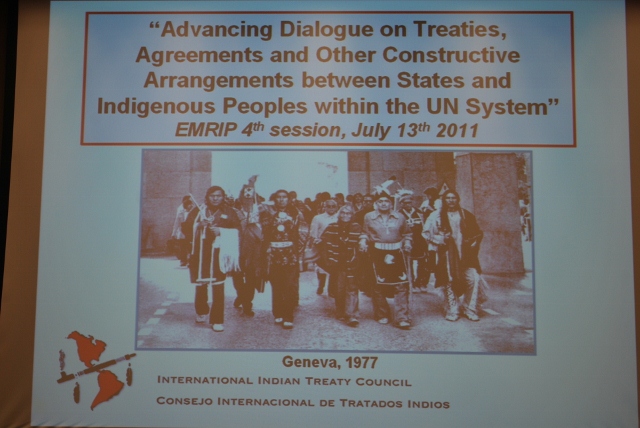
Advancing Dialogue on Treaties between States and Indigenous Peoples

The International Indian Treaty Council (IITC) hosted a lunch-time event on 13 July during the 4th Session of the Expert Mechanism on the Rights of Indigenous Peoples (EMRIP). The event was entitled "Advancing Dialogue on Treaties, Agreements and Other Constructive Arrangements between States and Indigenous Peoples within the UN System". It began by looking back at Indigenous peoples' participation in the United Nations, most notably, when Treaty Nations leaders were denied access to the League of Nations in 1923, and the 1974 Declaration of Continuing Independence of the Sovereign Native American Indian Nations. Presentations and discussion centered around the importance of treaties as sacred agreements and partnerships between Indigenous peoples and states, rooted in language, cultural tradition, and ceremony. They also called for greater international pressure upon states to implement existing treaties and agreements with Indigenous peoples, and to consider the effects of agreements between colonial governments and the successive governments on Indigenous peoples. Overall, it was stressed that treaties are an important part of Indigenous peoples' inherent rights to self-determination, survival, and well-being; they also enshrine responsibilities to and senses of connection with territories and future generations.

Recent recognition of treaties as having international standing can be found in Article 37 of the United Nations Declaration on the Rights of Indigenous Peoples (UNDRIP); Article 23 of the OAS-proposed American Declaration on the Rights of Indigenous Peoples; and former Special Rapporteur Miguel Alfonso Martinez's "Study on treaties, agreements and other constructive arrangements between States and indigenous peoples". Speakers included Andrea Carmen, Chief Wilton Littlechild, Grand Chief Edward John, Jose Carlos Morales, Atayu Abdulani, and a representative from the UN Office of the High Commissioner for Human Rights.

Tuesday, July 12, 2011

Indigenous Peoples' Traditional Knowledge and Intellectual Property

On 12 July, during the 4th Session of the Expert Mechanism on the Rights of Indigenous Peoples (EMRIP), the World Intellectual Property Organization (WIPO) hosted a lunch-time event entitled "Indigenous Peoples' Traditional Knowledge and Intellectual Property". Wend Wendland (WIPO Traditional Knowledge Division) provided an overview of the conventional intellectual property rights system in relation to traditional knowledge, traditional cultural expressions, and genetic resources. While acknowledging that WIPO Member States are currently negotiating towards an international legal instrument in attempt to ensure the effective protection of these three things, he noted that intellectual property does not provide a holistic response to the need for protecting traditional knowledge and cultural expressions.

Les Malezer (National Congress of Australia's First Peoples) noted that the WIPO negotiations are only the second international process (after the Convention on Biological Diversity negotiations towards the Nagoya Protocol on Access and Benefit Sharing) to address Indigenous peoples' rights since the adoption of the United Nations Declaration on the Rights of Indigenous Peoples (UNDRIP). He argued that Indigenous peoples' rights are still not well-understood at the international and domestic levels and that international processes continue to ignore historical injustices and fundamental rights such as self-determination. He said that the rooting of international processes in the principle of state sovereignty fails to acknowledge customary rights and sovereignty over natural resources, as enshrined in UNDRIP.

Sunday, July 10, 2011

EMRIP Session on the Right to Participate in Decision-making

Natural Justice is attending the fourth session of the Expert Mechanism on the Rights of Indigenous Peoples (EMRIP), which will take place in Geneva from 11-15 July. This session will focus on Indigenous peoples and the right to partcipate in decision-making. The provisional agenda, draft programme of work, and draft report are available online. EMRIP was established by the United Nations Human Rights Council in 2007 and is comprised of five independent experts on Indigenous peoples.