Showing posts with label EMRIP. Show all posts

Friday, July 11, 2014

Seventh Session of EMRIP Wraps Up in Geneva

Joseph Itongwa, presenting at the NJ-ICCA
Consortium side event on access to justice
The 7th Session of the Expert Mechanism on the Rights of Indigenous Peoples (EMRIP-7) took place from 7-11 July 2014 at the UN Headquarters (Palais des Nations) in Geneva. This session included a continuation of last year’s thematic study on access to justice, with a focus on Indigenous women, children, and persons with disabilities, as well as a new thematic study on disaster risk reduction. Natural Justice also co-hosted a lunch-time event with the ICCA Consortium on Monday 7 July. Overall, two key points of particular importance were: a) the multiple references to environmental issues (a notable shift over the past few sessions of EMRIP), and b) a more nuanced look at the special rights and types of marginalisation of groups within Indigenous peoples (women, youth and children, and persons with disabilities).

The Session saw a turnover in the Experts, with a new expert for the Asian region (Mr. Edtami Mansayagan from the Philippines) beginning his three-year term. The zero draft of the outcome document for the World Conference on Indigenous Peoples created much discussion, while the continuation of the study on access to justice raised a number of issues concerning Indigenous peoples' lands, territories and resources as well as reconciliatory and transformative justice.

When the draft study on disaster risk reduction was being considered, Natural Justice and the Indigenous Peoples of Africa Coordinating Committee (IPACC) made a joint statement, presented by Joseph Itongwa, on on climate change and vulnerability, traditional knowledge systems, customary tenure rights and legal recognition and support for customary natural resource governance, and the role of territory-based systems of natural resource governance and conservation in climate change mitigation and adaptation and prevention of disasters. Several suggestions were taken on board in the revised version of the study and the Expert Mechanism Advice No. 7 contained therein, which is expected to be adopted at the next Human Rights Council session in September 2014.

Monday, July 7, 2014

Natural Justice and ICCA Consortium Host Event at EMRIP-7

On Monday 7 July, Natural Justice and the ICCA Consortium co-hosted a lunch-time event at the 7th Session of the Expert Mechanism on the Rights of Indigenous Peoples (EMRIP-7) on access to justice, the UN Declaration on the Rights of Indigenous Peoples, and Indigenous peoples' and community conserved areas (ICCAs).

Holly Jonas (Natural Justice and ICCA Consortium International Policy Assistant) provided an introduction to ICCAs and access to justice. Emma Courtine (ICCA Consortium Programme Assistant) and Golshan Chahian (Cenesta, pictured at right) presented on a process for implementing rights-based approaches with the Indigenous nomadic tribes of Iran, which includes ICCA recognition, biodiversity conservation, sustainable livelihoods, and re-empowerment. On the latter in particular, Cenesta has a legal work group that aims to achieve nomad-friendly national laws and consists of four main bodies: tribal elders with knowledge of customary laws as legal advisors, lawyers, advocacy, and barefoot lawyers. Through this process, for the first time in national legislation history, Indigenous peoples and local communities in Iran provided suggestions for review and revisions of key national laws, which led to the inclusion of a new chapter on peoples’ participation and rights of Indigenous peoples and local communities.

Friday, July 12, 2013

EMRIP Side Event on the Relationship between ICCAs and Access to Justice

At the Sixth Meeting of the Expert Mechanism on the Rights of Indigenous Peoples (EMRIP) a side event was hosted on 11 July by Natural Justice, the ICCA Consortium and the Indigenous Peoples of Africa Coordinating Committee (IPACC) to discuss the relationship between access to justice and Indigenous peoples’ and community conserved territories and areas (ICCAs).

Grazia Borrini-Feyerabend (ICCA Consortium) opened the expert panel with an introduction to the concept of ICCAs and stories of diverse ICCAs around the world. Two local examples from the Indigenous Pygmy peoples from North Kivu (Joseph Itongwa, PIDP-Kivu) and from the Ogiek peoples (Daniel Mpoiok Kobei, Ogiek Peoples’ Development Program) from Kenya followed. Marie Wilke (Natural Justice), Nigel Crawhall (IPACC Secretariat) and Kanyinke Sena (Chairperson, UN Permanent Forum on Indigenous Issues) concluded the panel with presentations and statements on the legal perspective and the opportunities provided by the legal recognition of ICCAs as a means of environmental conservation.

The panel and the audience concluded that the concept of ICCAs provides a great opportunity for Indigenous peoples’ and local communities’ self-determination as it enables them to emphasise the benefit of their customary practices to society at large in the form of conservation, rather than simply arguing from their position as rights-bearers. Recognition of ICCAs in turn would also achieve recognition of land titles, collective rights and legal standing for customary institutions.
More information about EMRIP 6, including the draft study on access to justice, is available here. Submissions by Natural Justice to the study on access to justice are available here.
The full event report is available here.

Thursday, May 30, 2013

World Bank Steps Up Discussions with Indigenous Groups at this Year's UN Permanent Forum on Indigenous Issues

Photo Credit: UNPFII
During this year’s Permanent Forum on Indigenous Issues the World Bank engaged with Indigenous Peoples in a number of formal and informal sessions. Formally these engagements took place during plenary sessions of the Permanent Forum and informally during side events and organized dialogues. The size of the World Bank's team attending the Forum, which came up to 30 people in comparison to just a handful during last year's event, demonstrates the increased relevance the institution places on recognizing indigenous peoples as an important constituent in its work. 
The World Bank’s most important item of engagement was the review process with respect to its social and environmental safeguards that the World Bank is currently undertaking, which include a policy on indigenous peoples (Operational Policy 4.10). As the current policy was drafted in 2005, many of the numerous comments made by Indigenous Peoples during the discussions related to a demand to bring the policy in line with the UN Declaration on the Rights of Indigenous Peoples (UNDRIP 2007), including the right to free, prior and informed consent (FPIC). Furthermore, representatives called on the World Bank to not only examine the impact of UNDRIP on OP 4.10 but on all of the Bank’s policies.  It was highlighted that the importance of updating OP 4.10 cannot be overestimated, as in 2012 alone the safeguards were triggered by 20% of all World Bank projects, not including projects where they potentially should have been triggered but were not.

Tuesday, February 12, 2013

EMRIP Submission on Indigenous Peoples and Access to Justice

Orang asli (Indigenous peoples) of Malaysia celebrate a
successful High Court judgment in 2012. Photo via The Star.
On 11 February, Natural Justice made two submissions to a Human Rights Council-mandated study by the Expert Mechanism on the Rights of Indigenous Peoples (EMRIP) on access to justice in the protection and promotion of the rights of Indigenous peoples. The draft study will be presented at the sixth session of EMRIP in July.

The first submission had a global focus and consisted of two parts. Part I included inputs and experiences from several countries in Asia, Africa, and North and South America, with particular emphasis on the protection and stewardship of Indigenous peoples’ customary territories and resources. These were primarily drawn from a series of legal reviews coordinated in 2012 by Natural Justice and Kalpavriksh on behalf of the Indigenous Peoples’ and Community Conserved Territories and Areas (ICCA) Consortium.  It focused on the following themes before setting out key recommendations from the legal reviews:
  1. The relationship between access to justice and a range of other Indigenous peoples’ rights;
  2. Systemic and structural threats to Indigenous peoples’ rights and their territories and resources;
  3. Judicial systems themselves as a barrier to justice;
  4. Landmark judgments;
  5. Landmark legislation; and
  6. Continuing challenges with implementation and compliance.

L’accès à la Justice des Autochtones Pygmées en Province du Nord Kivu

Mission de médiation foncière entre les populations
autochtones pygmées et non pygmées dans 4 localités
du Groupement Ufamandu 1er, en territoire de Masisi.
Photo de PIDP-Kivu.
En date du 11 février 2013, Natural Justice, en collaboration avec le Programme d’Intégration et de Développement du Peuple Pygmée au Kivu (PIDP-Kivu) a soumis une étude conjointe sur l’accès à la justice des autochtones pygmées dans la province du Nord Kivu, au Mécanisme d’Expert des Nations Unies sur les Droits des Peuples Autochtones.

Cette étude décrit les difficultés auxquelles sont confrontés les autochtones pygmées en province du Nord Kivu pour accéder à la justice. Ces difficultés sont liées essentiellement à la marginalisation croissante des pygmées au sein de la société congolaise, l’analphabétisme, ainsi que le manque d’information concernant les lois et le système judiciaire en général.

Friday, January 25, 2013

UN Human Rights Bodies' Jurisprudence on Indigenous Peoples

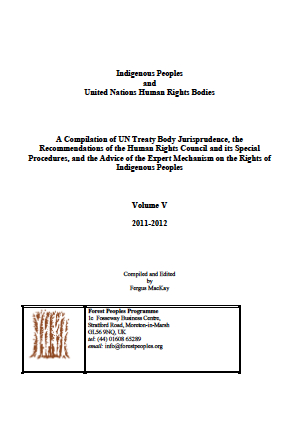
In the rapidly changing field of international Indigenous rights, it can be difficult to track new developments. To address this gap, the Forest Peoples Programme has been monitoring all developments around the rights of Indigenous peoples in UN human rights bodies in a series entitled “A Compilation of UN Treaty Body Jurisprudence, the Recommendations of the Human Rights Council and its Special Procedures, and the Advice of the Expert Mechanism on the Rights of Indigenous Peoples.” They recently released the 5th volume in this compilation, which covers the jurisprudence of UN human rights bodies pertaining to Indigenous peoples from 2011-2012 and was compiled and edited by Fergus MacKay. 

The publication can be accessed here. For further information, see the volumes from 2009-2010, 2007-2008, 2005-2006 and 1993-2004.

Monday, November 19, 2012

Two Opportunities for EMRIP Submissions

Via www.ohchr.org
Two significant opportunities are available to contribute to the Expert Mechanism on the Rights of Indigenous Peoples' (EMRIP) work to develop and monitor the implementation of law and policy around Indigenous people’s rights. The first is a survey for Indigenous peoples on strategies for implementing the United Nations Declaration on the Rights of Indigenous Peoples (UNDRIP). The survey can be completed online here and should be submitted by 18 February, 2013. 

The second is an opening for contributions by Indigenous peoples, academia, national human rights institutions, civil society and other interested groups and persons  on EMRIP's study on access to justice in the promotion and protection of Indigenous peoples’ rights. There is no prescribed form for submissions, and contributions should submitted via email to expertmechanism@ohchr.org by 11 Febrary, 2013.

Sunday, July 10, 2011

EMRIP Session on the Right to Participate in Decision-making

Natural Justice is attending the fourth session of the Expert Mechanism on the Rights of Indigenous Peoples (EMRIP), which will take place in Geneva from 11-15 July. This session will focus on Indigenous peoples and the right to partcipate in decision-making. The provisional agenda, draft programme of work, and draft report are available online. EMRIP was established by the United Nations Human Rights Council in 2007 and is comprised of five independent experts on Indigenous peoples.