 FAO has just published 'State of the World's Forests 2014'. The
report – available here, along with various other briefs - looks a the
potential that the world’s forests, trees on farms, and agroforestry systems have
in supporting the livelihoods of rural people by providing employment, energy,
nutritious foods and a wide range of other goods and ecosystem services. There
has been a lack of clear evidence of this, which the report seeks to address by
systematically gathering and analyzing available data on forests’ contributions
to people’s livelihoods, food, health, shelter, and energy needs.
FAO has just published 'State of the World's Forests 2014'. The
report – available here, along with various other briefs - looks a the
potential that the world’s forests, trees on farms, and agroforestry systems have
in supporting the livelihoods of rural people by providing employment, energy,
nutritious foods and a wide range of other goods and ecosystem services. There
has been a lack of clear evidence of this, which the report seeks to address by
systematically gathering and analyzing available data on forests’ contributions
to people’s livelihoods, food, health, shelter, and energy needs.
Showing posts with label FAO. Show all posts
Showing posts with label FAO. Show all posts
Monday, June 30, 2014
FAO's State of the World's Forests 2014 Report Published
FAO has just published 'State of the World's Forests 2014'. The
report – available here, along with various other briefs - looks a the
potential that the world’s forests, trees on farms, and agroforestry systems have
in supporting the livelihoods of rural people by providing employment, energy,
nutritious foods and a wide range of other goods and ecosystem services. There
has been a lack of clear evidence of this, which the report seeks to address by
systematically gathering and analyzing available data on forests’ contributions
to people’s livelihoods, food, health, shelter, and energy needs.

Saturday, March 2, 2013
FAO Report: Biofuels and the Sustainability Challenge

Via the International Institute for Sustainable Development (IISD), the UN Food and Agricultural Organisation has released a new report entitled “Biofuels and the Sustainability Challenge.”
From the summary by IISD, the report “addresses the issue of biofuel sustainability based on a global assessment of major commodities and feedstocks. The report is guided by the need to understand the economic, environmental and social sustainability dimensions of biofuels, and how these elements can be used to address the challenges of land-use change, food security and climate change. The report evaluates the role of biofuel certification schemes in promoting sustainability. It relies on a survey of a large number of country case studies, as well as analyses of trends in crop policies, production and markets. The report questions whether certification schemes are adequate to assure sustainability.”
Thursday, January 24, 2013
FAO Journal on UN Guidelines on Tenure of Land, Fisheries and Forests
 The UN Food and Agriculture Organization’s Land Tenure Journal’s latest edition examines the Voluntary Guidelines on the Responsible Governance of Tenure of Land, Fisheries and Forests in the Context of National Food Security. The Guidelines, which were recently endorsed by the Committee on World Food Security, are still widely unknown and the four articles in the peer-reviewed, open-access journal seek to explain their contents, their development and the strategies for implementing them.
Tuesday, January 8, 2013
Guide to Investing in Locally Controlled Forestry
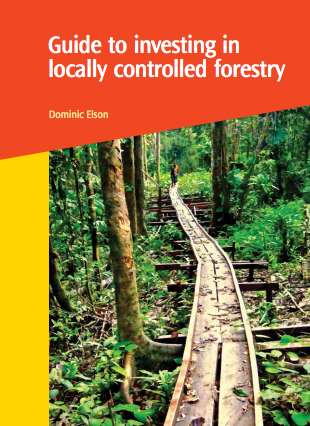
The Growing Forest Partnership initiative, in partnership with the UN Food and Agricultural Organisation, the International Institute for Environment and Development, the International Union for Conservation of Nature, The Forests Dialogue and the World Bank, has released a “Guide to Investing in Locally Controlled Forestry” authored by Dominic Elson.
Per the press release, the guide “emerged out of 11 international dialogues that assembled more than 400 people to discuss how to make investing in locally controlled forestry (ILCF) happen. It is a primarily a tool for practical action – providing guidance on how to structure enabling investments and prepare the ground for asset investments that yield acceptable returns and reduced risk, not only for investors, but also for local forest right-holders, national governments and society at large. After providing strong justification for this approach, the guide sets out a framework for structuring investments with tactical advice for building the partnerships necessary for successful ILCF.”
Tuesday, November 20, 2012
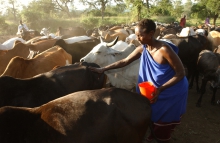
FAO Study on Women's Role in Livestock Conservation
 |
| Via www.fao.org |
While two-thirds of the world’s 600 million livestock keepers are women, the role of women in conservation and breeding indigenous livestock remains poorly documented and undervalued. A new UN Food and Agriculture Organisation (FAO) study, entitled “Invisible Guardians: Women manage livestock diversity,” seeks to address this shortcoming.
The report notes the capacity of indigenous livestock breeds to adapt to harsh climates, resist disease, thrive on local fodder, and support themselves with low maintenance. The report argues that the role that women play in conserving and breeding these livestock has been significantly underappreciated. Study author and Natural Justice-partner Ilse Köhler-Rollefson argues that women are the guardians of livestock diversity. The report offers specific guidelines to ensure that gender issues are made central to projects, programmes and policies that focus on animal genetic resource management.
A summary of the report, along with a supplementary interview with study author Ilse Köhler-Rollefson, can be accessed here. The report can be downloaded here. An interview with Dailibai Raika, a livestock activist from Rajasthan, has been produced as a supplement to the brief and can be viewed here.
Subscribe to:
Posts (Atom)