Showing posts with label Green Economy. Show all posts

Tuesday, March 25, 2014

2014 SEED South Africa Symposium

Cath Traynor
Cath Traynor of Natural Justice attended the 2014 SEED South Africa Symposium “Advancing the Green Economy: creating jobs and opportunities for green enterprises” held on 19-20 March 2014 in Pretoria, South Africa. SEED stands for supporting entrepreneurs for sustainable development. Natural Justice’s Bio-cultural Community Protocols was a 2009 Gold winner in the SEED awards.

Over 150 participants including 40 entrepreneurs from private sector, civil society, academia, media, and government gathered to exchange experience, knowledge and perspectives that could advance the growth of socio-environmental entrepreneurship in South Africa. Sessions included creating green jobs and the impact of social and environmental start-ups, growing enterprises, and barriers, success factors and enablers to support enterprises. Key issues that arose included accessing financing during the initial phases of start-ups, encouraging investors to deal with risks and to understand the human value of initiatives, the limited voice and impact small enterprises have at policy level, the lack of understanding of the potential of SMMEs within the general public, and also insufficient support from government and within the regulatory environment. Discussions focussed upon finding solutions to common problems experienced by small enterprises in South Africa.

Saturday, December 7, 2013

African Views on Green Development: A Multi-stakeholder Dialogue

From 4-5 December 2013, Natural Justice, together with the Open Society Initiative for Southern Africa and the Heinrich Böll Foundation, hosted the ‘African Views on Green Development: A Multi-stakeholder Dialogue’ in Cape Town. Over 25 participants from the region representing civil society organisations, multilateral organisations, research institutes and academia attended. 

The objectives of the dialogue were to consider practical experiences across Africa on diversifying rural economies, localising development and increasing sustainable production to aid in the formation of policy positions that inherently reflect African needs and interests as input for the global green development agenda. The dialogues opened with an introduction to green development and the concept of the green economy. Sessions included the macro-economic scale of green development which considered the need to move towards sustainability-orientated investments, the likelihood of reforms within the capitalist system, and the importance of values and principles to underpin green development. A separate session explored locally-driven green development opportunities, best-practices were presented, and enabling conditions required for a green transition to support community rights discussed. A green employment and trade session examined creating jobs and opening markets, the need for decent jobs, job creation tools such as government spending and taxation, and the positive and negative impacts of greening the economy on jobs and different interest groups. In the final session participants deliberated the post-2015 development agenda, and opportunities and strategies for diverse organisations to positively influence the process. The dialogues wrapped up by identifying priority areas for future engagement. 

A summary report of the dialogues will be produced, and in 2014 strategic think pieces will be commissioned which will contribute African perspectives to the global process shaping the post-2015 development agenda.

Monday, June 24, 2013

Forever Sabah Workshop with Community Conservation Leaders

A selection of community conservation initiatives from
around Sabah and a timeline of key events.
From 21-22 June, Holly Shrumm (Natural Justice) joined a Forever Sabah workshop of community conservation leaders. Forever Sabah is a 25-year initiative that aims to build a fair, prosperous and sustainable Sabah (Malaysia) by pioneering the state’s transition to a diversified green economy. It aims to change the development and economic trajectory of the State by rebalancing the economy from its historical over-reliance on and exploitation of natural habitats (particularly forests, rivers and seas).

The workshop focused on more than ten leading community conservation initiatives, including Native Forest Reserves, Community Use Zones (co-management with state protected areas), reforestation, eco-tourism, and natural resource-based enterprises. It used Open Space Technology to identify, explore, and brainstorm next steps on a range of key issues such as land, sustainable use of natural resources, economic opportunities, and leadership.

Tuesday, February 5, 2013

RRI Reports on Secure Land Tenure

The Rights and Resources Initiative has released two ground-breaking reports highlighting the importance of secure land tenure in broader national and international law and policy and for investors. 

“Landowners or Laborers: What choice will developing countries make?” considers the implications of policies, especially in Africa, that seek rapid development by ceding control of land and resources to external actors. It contrasts these policies with the successes of China and Brazil, which have achieved advances through establishing local property rights rather than undercutting them. It further summarises the state of resources and rights globally, and identifies the key choices and challenges faced by developing countries in 2012. The report can be downloaded here

“The Financial Risks of Insecure Land Tenure: An Investment View” considers the assumption that cheap land can be acquired to derive high profits easily. The report challenges this view, arguing that exploiting land with disputed tenure rights leads to significant risks. The paper can be downloaded here.

Tuesday, January 8, 2013

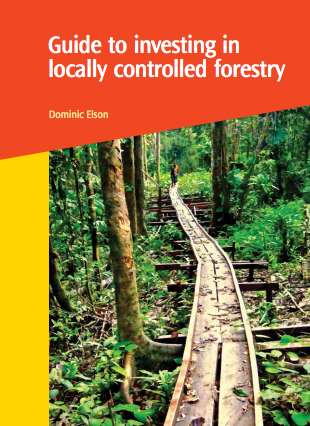
Guide to Investing in Locally Controlled Forestry


Per the press release, the guide “emerged out of 11 international dialogues that assembled more than 400 people to discuss how to make investing in locally controlled forestry (ILCF) happen. It is a primarily a tool for practical action – providing guidance on how to structure enabling investments and prepare the ground for asset investments that yield acceptable returns and reduced risk, not only for investors, but also for local forest right-holders, national governments and society at large. After providing strong justification for this approach, the guide sets out a framework for structuring investments with tactical advice for building the partnerships necessary for successful ILCF.” 

Read more about the guide here. Download the guide directly here.

Monday, November 19, 2012

Resource Media Report on Ecosystem Services Messaging and Strategy

Via the Ecosystem Services for Poverty Alleviation (ESPA) research programme, a new report has been released by Resource Media on public communications strategies and "messaging" for ecosystem service policies. The report was developed through in-depth interviews with ecosystems services practitioners, government officials, and other stakeholders, through a survey of media and digital coverage of ecosystem services projects, and a review of a wide range of materials produced by practitioners. The report finds that out of 16 terms to describe the benefits of nature, “ecosystem services” and “natural capital” ranked 13th and 15th, respectively, as the terms were found to be difficult to understand and inadequate in conveying meaning by those surveyed. 

On messaging, the report recommends a clearer discussion of nature’s value and benefits instead of using the term ‘ecosystem services’. To achieve this, it recommends discussing specific lands and areas, the acknowledgement of nature’s intangible and incalculable benefits, increased emphasis on the gap in traditional economic analysis’s ability to understand and quantify nature’s benefits, and using plain English over jargon. 

Find a summary of the report’s findings on ESPA’s blog here. Download the full report here.

Friday, September 21, 2012

E-Module on REDD+ for Communities

Human activities are consuming huge amounts of fossil fuels and raw materials that are creating massive amounts of persistent gases that are dramatically changing weather patterns in unpredictable ways. Deforestation contributes an estimated 18-25% of carbon emissions. The idea behind the Reducing Emissions from Deforestation and Forest Degradation in Developing Countries (REDD+) programme is to generate funds to reduce emissions through forest conservation in order to slow the onset of climate change. Since most of the world’s remaining forests are in the ‘developing world’ and most of the world’s emissions are from the ‘developed world’, the majority of funding for REDD+ will be directed from the latter to the former. As REDD+ is implemented, communities will be significantly impacted, often negatively. 

In this context, Natural Justice has prepared a draft e-module on REDD+ for communities. The module seeks to prepare communities, especially communities developing biocultural community protocols, to engage proactively with the international framework of REDD+. It briefly describes the rationale behind and plans for REDD+. It then looks at the key issues that have emerged around REDD+, focusing especially on the concerns with its current status and the safeguards that are being developed to attempt to protect community rights. It closes by looking at the current forms in which REDD+ is being implemented. 

The full e-module can be downloaded here. Other e-modules drafted by Natural Justice can be accessed here. These modules supplement ‘BCPs: A Toolkit for Community Facilitators’, which can be viewed here. The documents are not final and any comments can be directed to Holly Shrumm (holly (at) naturaljustice.org) and Harry Jonas (harry (at) naturaljustice.org).

Saturday, March 24, 2012

Forever Sabah Stakeholder Meeting

Last week Harry Jonas attended an NGO stakeholder meeting for a bold new project being developed in Malaysia: Forever Sabah. The meeting was convened by LEAP and attended by a range of NGOs including Borneo Conservancy, PACOS, Hutan, WWF, and Global Diversity Foundation. Forever Sabah is a full-scale reintegration of economic, social and environmental issues at the landscape level towards a paradigm shift to a "greener" economic and governance model. Harry provided input on Natural Justice's work on the green economy and green governance, about which more can be read here. More information on Forever Sabah can be found on LEAP's website.

Wednesday, August 17, 2011

Recap: Meeting on Green Governance and the Green Economy

From 15-16 August, Natural Justice and the Indigenous Peoples of Africa Coordinating Committee (IPACC) co-hosted a meeting of Indigenous African leaders on the United Nations Environmental Programme (UNEP) Green Economy Initiative. The first day of the meeting focused on discussing and understanding the content and implications of the UNEP Green Economy Initiative with respect to governance over their territories and stewardship over their resources.

During the second day, participants prepared the first draft of a statement of African Indigenous principles to further engage the Green Economy Initiative based on the bio-cultural or stewardship rights of African Indigenous peoples over their territories and resources within international and domestic law and policy. Participants also elaborated an action plan for sharing these principles and views with the African Group of Negotiators in the so-called Rio Conventions (UNCBD, UNFCCC, and UNCCD), with influential policy bodies such as African Ministerial Conference on the Environment (AMCEN), UNEP, and the International Union for Conservation of Nature (IUCN), and with the Global Indigenous Peoples' Caucus and IPACC’s members and allies. The meeting was supported by UNEP and the Open Society Initiative for Southern Africa (OSISA).

Monday, August 15, 2011

Meeting on Green Governance and the Green Economy

From 15-16 August in Cape Town, Natural Justice, in partnership with the Indigenous Peoples of Africa Coordinating Committee (IPACC) will be organizing a meeting of representatives of African Indigenous peoples on "The Green Economy Initiative: Green Governance Challenges". The meeting seeks to ensure that Indigenous African leaders understand the content and implications of the United Nations Environment Programme (UNEP) Green Economy Initiative with respect to governance over their territories and stewardship over their resources.

As an outcome of the meeting, IPACC and Natural Justice will cooperate to produce a response document that sets out African Indigenous views on the Rio processes, low carbon economics, strengths and weaknesses of the UNEP Initiative, challenges of governance and accountability, identification of opportunities for Indigenous peoples to conserve biocultural diversity and protect traditional knowledge, and traditional knowledge-related innovations and genetic resources. The document will further engage the UNEP Green Economy Report based on the biocultural rights of African Indigenous peoples over their territories and resources within international and domestic law and policy. The meeting will be supported by UNEP and the Open Society Initiative for Southern Africa (OSISA).