Showing posts with label FPP. Show all posts

Friday, November 7, 2014

Yangon Conference on Human Rights and Agribusiness

Large-scale agribusiness (particularly monoculture plantations such as oil palm and sugarcane) causes widespread human rights violations and environmental degradation in Southeast Asia. This pervasive industry was the focus of a workshop held from 4-6 November 2014 in Yangon, Myanmar, which was convened by the Myanmar National Human Rights Commission, with the support of the Forest Peoples Programme, RECOFTC-The Center for People and Forests, and the Rights and Resources Initiative.

With 65 participants from the South East Asian National Human Rights Institutions Forum (SEANF) and supporting civil society organisations, including from Cambodia, Indonesia, Lao PDR, Malaysia, Myanmar, the Philippines, and Thailand, the workshop addressed interlinked issues such as extraterritorial investments, migrant labour and human trafficking, and food security, and illustrated the range of experiences and modalities of each National Human Rights Institution. In addition to series of panel presentations, the workshop featured engaging break-out groups on transitioning from voluntary to binding standards for transnational and other companies, and on improving, scaling up and innovating upon conflict resolution mechanisms at various levels. On the final day, participants adopted by consensus the Yangon Statement on Human Rights and Agribusiness in Southeast Asia, which calls for (among other things) strengthened regional cooperation with the Association of South Eas Asian Nations (ASEAN) Inter-governmental Commission on Human Rights, establishment of an ASEAN Human Rights Court and effective national-level complaints and redress mechanisms, and active coordination with certification bodies such as the Roundtable on Sustainable Palm Oil.

Wednesday, July 2, 2014

Developing FPIC Guidance for Oil Palm Companies

Indigenous community representative from West Malaysia.
Though not without its critics, the Roundtable on Sustainable Palm Oil (RSPO) is an important forum for developing voluntary certification standards and has the potential to tip the balance of the industry in favour of a more viable path for conservation and people, alongside economic development.

In 2008, Forest Peoples Programme published a guide to free, prior and informed consent (FPIC) for RSPO member companies. With the recent revision of the RSPO's Principles and Criteria, Forest Peoples Programme is accordingly updating the FPIC guidance in collaboration with Natural Justice and other members of the new Human Rights Working Group. As part of this process, the first of two stakeholder consultation workshops was held in Kuala Lumpur, Malaysia, from 30 June to 1 July. The objectives of the meeting were:
  • To listen to the views of all parties on what constitutes a successful process for recognising the right of indigenous peoples, local communities and other users to give or withhold their FPIC to land acquisition for the establishment of oil palm plantings;
  • To learn lessons from communities, companies, auditors and NGOs and from Social Impact Assessments, complaints and dispute resolution about what has and has not worked;
  • To contribute insights into how the RSPO Guide for Companies on FPIC can be strengthened; and
  • To examine more broadly FPIC in relation to the planning and establishment of oil palm holdings, including the possibility of joint ventures with communities, communities leasing lands, communities as smallholders and other options.
Participants included representatives of Indigenous peoples from West Malaysia, Sabah, and Sarawak, supporting NGOs, oil palm companies, and RSPO Secretariat staff. Holly Jonas (Natural Justice) presented on FPIC in international law. The outcomes of this and the second workshop in Jakarta (to be held in late July) will be incorporated into the revised guidance, release of which is planned for the next RSPO Roundtable in November. For any questions, please contact holly (at) naturaljustice.org.

Friday, June 20, 2014

New Report on Indigenous Peoples’ Rights, Forests and Climate Policies in Guyana

The Forest Peoples Programme (FPP) and the Amerindian Peoples Association (APA) have published a new special report entitled ‘Indigenous Peoples’ Rights, Forests And Climate Policies In Guyana: A Special Report'. The report, edited by Kate Dooley and Tom Griffiths, highlights the vital need for good land tenure governance in the development of sustainable forest and climate initiatives.

One for the key findings, based on detailed fieldwork, is  that insecure land rights and gaps in national legal frameworks as they relate to indigenous peoples’ rights are a major obstacle to the effective and efficient implementation of national land use and climate policies in Guyana.

The authors call  for timely reforms and strengthening of national laws and policies to ensure proper protections for customary land rights and adherence to the core standard of free, prior and informed consent (FPIC).

The report also underlines the pressing need for robust measures by bilateral and multilateral international agencies to ensure compliance with their own safeguard policies in ongoing forest governance, livelihood, infrastructure, energy and climate programmes.

Thursday, November 7, 2013

New Research Questions Effectiveness of RSPO Standards

"Members of the Roundtable on Sustainable Palm Oil (RSPO) are violating the rights of indigenous peoples and local communities in the forests and peatlands of tropical nations worldwide, according to a new research publication released today. The study details the performance of 16 oil palm operations, many run by RSPO members, reporting on their failure to uphold human rights and environmental standards required.

'Since its founding eight years ago, the RSPO has adopted good standards, but too many member companies are not delivering on these paper promises,' said Norman Jiwan, Executive Director of Transformasi Untuk Keadilan Indonesia, a human rights organisation based in Jakarta. 'The RSPO could still meet this challenge if it provides remedies for member companies’ impacts on communities, but for that we need much stricter enforcement. The organisation’s very credibility is at stake.'

The book 'Conflict or consent? The oil palm sector at a crossroads' details cases in which palm oil producers have failed to obtain permission from communities - a process required by the RSPO based on the UN mandate that is known as free, prior and informed consent. The findings also support accounts of the destructive impact that the palm oil developments are having on indigenous peoples and local communities." To download the report, edited by Marcus Colchester and Sophie Chao (Forest Peoples Programme), and related materials, please visit: http://www.forestpeoples.org/press-room.

Source: Forest Peoples Programme Press Release, 6 November 2013

Thursday, February 28, 2013

FPP Resource on RSPO Dispute Resolution System

Via www.forestpeoples.org/
The Forest Peoples' Programme has produced a booklet documenting the dispute resolution system of the Roundtable on Sustainable Palm Oil (RSPO), a not-for-profit association formed in 2004 in response to the urgent and pressing global call for sustainably produced palm oil. While the document identifies numerous shortcomings with the RSPO complaints system, it seeks to ensure that communities are capable of accessing the current system. According to the booklet, "it provides basic information and guidance to civil society organisations and affected local communities on how the RSPO complaint process works and the various steps involved in submitting a complaint."

The booklet can be downloaded here

Friday, January 25, 2013

UN Human Rights Bodies' Jurisprudence on Indigenous Peoples

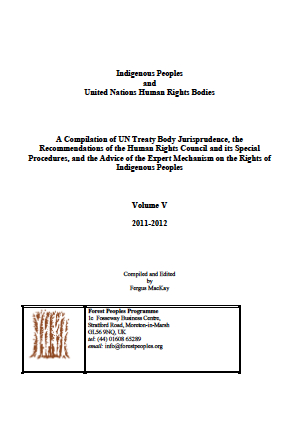
In the rapidly changing field of international Indigenous rights, it can be difficult to track new developments. To address this gap, the Forest Peoples Programme has been monitoring all developments around the rights of Indigenous peoples in UN human rights bodies in a series entitled “A Compilation of UN Treaty Body Jurisprudence, the Recommendations of the Human Rights Council and its Special Procedures, and the Advice of the Expert Mechanism on the Rights of Indigenous Peoples.” They recently released the 5th volume in this compilation, which covers the jurisprudence of UN human rights bodies pertaining to Indigenous peoples from 2011-2012 and was compiled and edited by Fergus MacKay. 

The publication can be accessed here. For further information, see the volumes from 2009-2010, 2007-2008, 2005-2006 and 1993-2004.

Friday, November 30, 2012

Important Publications on REDD+ for COP 18

As government representatives gather to consider solutions to, and means to mitigate the impact of, climate change at the 18th Conference of Parties of the United Nations Framework Convention on Climate Change, several significant publications on the impact of climate change and Reducing Emissions from Deforestation and Forest Degradation (REDD+) on the rights of Indigenous peoples have been launched by Natural Justice partners. 

The Asia Indigenous Peoples Pact (AIPP) and the International Work Group for Indigenous Affairs (IWGIA) have published a briefing paper entitled "REDD+, Rights and Indigenous Peoples: Lessons from REDD+ Initiatives in Asia." The brief examines how far countries participating in REDD+ in Asia have advanced in addressing the social and environmental safeguards needed for the implementation of REDD+ and reflects on pilot activities in Nepal, Cambodia and Vietnam. Their findings suggest that outstanding critical issues for Indigenous peoples include the lack of effective engagement, free, prior and informed consent, and unresolved land tenure and carbon rights issues. The brief can be downloaded here.  

The Forest Peoples Programme, has released a note that refers to the Indigenous Peoples Caucus position on REDD+ and analyses key issues and opportunities for Indigenous peoples to influence the current REDD+ negotiations in Doha. The note can be downloaded here

The Indigenous Peoples Caucus, on behalf of the International Indigenous Peoples Forum on Climate Change (IIPFCC), released a statement to the Subsidiary Body for Scientific and Technical Advice (SBSTA) concerning REDD+ which raised issues such as the need to respect collective and customary systems of forest governance and management, the roles and contributions of Indigenous women, and the need for an independent complaints mechanism. The statement can be accessed here.

Friday, November 2, 2012

Palm Oil Producer Violations Exposed

A series of major Asian palm oil companies that are members of the Roundtable on Sustainable Palm Oil (RSPO) have been exposed for violations of RSPO guidelines. As a recent press release from the Forest Peoples Programme (FPP) demonstrates in documenting several of these cases, these violations raise the question of whether the RSPO is actually able to enforce its own standards. 

It was recently established by Green Advocates, representing the Kru tribes in Liberia, that a subsidiary of Indonesia’s largest palm oil producer, Sina Mas, had clearly violated the RSPO’s New Planting Procedure by not advertising plans to clear and plant oil palms and not publicising a High Conservation Value Assessment. According to RSPO standards, the company should cease clearance until due process is followed, especially as community members have expressed concern that their land is being taken without their free, prior and informed consent. 

The FPP press release documents further violations of RSPO guidelines in Liberia, Cameroon, Malaysia, and Indonesia, many uncovered through a partnership between FPP, Sawit Watch and other partners to review the practices of 15 major palm oil companies in West Africa and Southeast Asia. It concludes by noting Sawit Watch’s concern that the RSPO must significantly improve its system as its credibility is clearly at stake. 

Find the full press release here. Download FPP and Sawit Watch’s review of 15 RSPO members practices here.

Wednesday, September 5, 2012

FPP Seeking Executive Director

Via www.forestpeoples.org
The Forest Peoples Programme (FPP) is seeking an experienced and dynamic person to serve as Executive Director. The person should be committed to the continued and successful development of FPP and its values, strategic goals and thematic programmes. 

The Executive Director will be responsible for shaping the collective vision and direction of FPP, coordinating all FPP activities, fundraising, and overseeing the management of personnel. A successful candidate will have experience in providing consensus-based leadership, an understanding of relevant issues and legal frameworks, significant experience working with Indigenous peoples and local communities, fundraising experience, leadership qualities, a proven capacity for research and writing, and fluency in English with proficiency in French and/or Spanish. 

Find the full job description and details on how to apply here. Read more about FPP here. Find FPP on Facebook here and follow FPP on Twitter at @ForestPeoplesP.

Tuesday, August 28, 2012

FPP Report: Indigenous Peoples and the Green Climate Fund

The Forest Peoples Programme and the Indigenous Peoples’ Network of Malaysia (JOAS) have drafted a technical briefing for Indigenous peoples, policy makers and support groups entitled Indigenous Peoples and the Green Climate Fund. The note seeks to offer background on and critically analyse the fund created to support global action on climate change at the 17th Conference of Parties to the United Nations Framework Convention on Climate Change, concluding that the “views and recommendations of Indigenous Peoples are not being taken fully into account.” 

The briefing includes a section on understanding the Green Climate Fund (GCF), offering basic details to those just learning about the GCF as well as summaries of the latest updates. The briefing also considers the key challenges faced by Indigenous peoples in the development of the GCF and lists three recommendations with detailed justifications: 1) ensuring effective environmental and social safeguards and a rights-based approach to climate financing; 2) ensuring Indigenous peoples’ access to a dedicated fund for financing climate change actions; and, 3) ensuring Indigenous peoples’ full and effective participation in governance. 

The full briefing can be downloaded here. Read more about the Forest Peoples Programme here, and follow them on Facebook here and on Twitter at @ForestPeoplesP.