Showing posts with label Indigenous Peoples Rights. Show all posts

Wednesday, March 2, 2016

Indigenous Fellowship Programme with OHCHR

The UN Human Rights Office of the High Commissioner call for applications for the senior indigenous fellowship is now open. The Indigenous Fellowship Programme (IFP) is a comprehensive programme which aims to contribute to build capacity and expertise of indigenous representatives in the UN system and mechanisms dealing with human rights in general and indigenous issues in particular. The IFP is accessible in four languages, it is held annually for 4-5 weeks in Geneva usually in June/July to coincide with the annual meeting of the Expert Mechanism on the Rights of Indigenous Peoples.

Please see the OHCHR IPF webpage for further information on how the programme works, who can apply, and how to apply.

The deadline for applications is 11 March 2016.

Thursday, December 17, 2015

Recognizing the Rights of Communities and Knowledge Holders in Climate Change Adaptation – UNFCCC COP21 Side Event

Ms. Swiderska, Dr. Reid, Mr. Argumendo, Dr. Song, Dr. Castro, Dr. Traynor & Mr. Le Fleur
(Photo courtesy of Matt Wright/IIED)

During the recent UN Climate Change Conference in Paris (30th November – 12th December), the Adaptation Committee released its 2015 Overview Report “Enhancing Coherent Action on Adaptation 2012-2015”, the publication provides information on adaptation to Parties and the broader adaptation community. Within the report the Adaptation Committee recommends that Parties underline the importance of indigenous and traditional knowledge (I&TK), and encourage their integration into National Adaptation Plans (NAPs). They suggest, one way that this integration can be supported is through enhancing the accountability and enforcing implementation of existing laws, rules and procedures dealing with I&TK and practices thus ensuring recognition of the rights of communities and holders of I&TK and practices throughout the adaptation process.

Natural Justice’s Dr. Cath Traynor’s presentation entitled “Indigenous Knowledge in Climate Change Adaptation: Recognition of the Rights of Communities and Knowledge Holders” spoke directly to this issue. Dr. Traynor was part of a panel on the NJ, GTA, IIED co-hosted Side Event “Supporting Poor, Vulnerable, and Indigenous Communities”, 7th December, 2015. Dr. Traynor introduced preliminary findings of the “Empowering Indigenous Peoples and Knowledge Systems Related to Climate Change Adaptation and Intellectual Property Rights” OCSDNet project, these included reflections on the university research ethics procedures, which although they seek to ensure the protection of and consent from human subjects, at the same time secures power relations, between ‘expert’ researchers who are seen to produce knowledge and vulnerable subjects who produce mere data. Efforts towards more open and collaborative research needs to understand these complex tensions that shape, and are shaped by, knowledge production and engage critically in the ethics procedures themselves. To ensure that community rights are recognized in adaptation, community-researcher contracts have also been developed, their purpose is to ensure that community intellectual property in adaptation is controlled and protected in accordance with the UN Declaration on the Rights of Indigenous Peoples, and South African Policies and Laws. Mr. Reino Le Fleur, Indigenous Griqua youth representative and Community Co-Researcher on the OCSDNet project, then shared his experiences and his plans for connecting youth with I&TK of their elders, a linkage which in some communities in South Africa is being lost due to the historical dispossession of lands, and the negative impacts of colonisation, apartheid and globalisation upon traditional livelihoods.

During the Side Event, Ms. Krystyna Swiderska (IIED), Mr. Alejandro Argumento (ANDES) and Dr. Yinching Song (Centre for Chinese Agricultural Policy, Chinese Academy of Science) discussed the importance of biocultural heritage in adaptation practices and highlighted 5 key actions and the benefits of farmer to farmer seed networks

Dr. Carlos Potiatra Castro (University of Brazillia/GTA) then shared experiences from the development of the Bailique Community Protocol, Brazil. The process entailed integrating customary norms and internal governance structures into the protocol, consideration of national and international legislation as it applies to the communities and public policies that they have a right to access. To date, the process has resulted in land regularisation, and empowerment of the communities to negotiate with external actors. The community protocol approach is highly relevant to landscape scale mitigation and adaptation programmes and projects and could also contribute to REDD+ as a recent Policy Brief illustrates (search for “BCPs” here).

Dr. Hannah Reid (IIED) then summarised a study that aimed to quantify the funding for local adaptation activities against ten principles intended to guide good ‘quality’ funding allocations. Projects scored well in terms of effectiveness, flexibility and sustainability but poorly on transparency, accountability and urgency.

The session drew to a close with questions from the audience, which included asking how a community is defined, and the pro’s and con’s of an I&TK database, and a wrap-up from Mr. Delfin Ganapin (UNDP-GEF Small Grants Programme). Presentations and related materials can be found on the UNFCCC Side Events webpage, search for the “Natural Justice” adaptation session held at 15:00-16:30 hrs, Monday 07 December, 2015. 

Friday, September 19, 2014

New RRI Report on Recognizing Community Land Rights

Rights and Resources Initiative has announced the release of their latest report Recognizing Indigenous and Community Land Rights: Priority Steps to Advance Development and Mitigate Climate Change. This report demonstrates how recognising community land rights is a cost-effective way to address a host of social, environmental, and development challenges.

Prepared with Tebtebba, the report reveals that US$1.64 billion -- the funds already pledged by three multilateral initiatives to developing the REDD+ carbon market -- would expand the recognition of land rights for local communities and Indigenous Peoples living on 450 million hectares, an area almost half the size of Europe. These cost estimates provide a benchmark for future climate change research and policy work as international negotiations to address greenhouse gas emissions heat up.

Friday, June 20, 2014

New Report on Indigenous Peoples’ Rights, Forests and Climate Policies in Guyana

The Forest Peoples Programme (FPP) and the Amerindian Peoples Association (APA) have published a new special report entitled ‘Indigenous Peoples’ Rights, Forests And Climate Policies In Guyana: A Special Report'. The report, edited by Kate Dooley and Tom Griffiths, highlights the vital need for good land tenure governance in the development of sustainable forest and climate initiatives.

One for the key findings, based on detailed fieldwork, is  that insecure land rights and gaps in national legal frameworks as they relate to indigenous peoples’ rights are a major obstacle to the effective and efficient implementation of national land use and climate policies in Guyana.

The authors call  for timely reforms and strengthening of national laws and policies to ensure proper protections for customary land rights and adherence to the core standard of free, prior and informed consent (FPIC).

The report also underlines the pressing need for robust measures by bilateral and multilateral international agencies to ensure compliance with their own safeguard policies in ongoing forest governance, livelihood, infrastructure, energy and climate programmes.

Wednesday, May 21, 2014

Natural Justice Contributes Chapter to New Book on Indigenous Peoples' Access to Justice

On 19 May 2014, the Columbia University Institute for the Study of Human Rights held a side event during the UN Permanent Forum on Indigenous Issues to launch a new book, "Indigenous Peoples' Access to Justice, Including Truth and Reconciliation Processes." The book arises out of an Expert Seminar on the same subject, held at Columbia University  from 27 February to 1 March 2013 that was co-hosted by the Office of the High Commissioner for Human Rights, the International Center for Transitional Justice and Columbia University.

Tuesday, May 13, 2014

13th Session of the UN Permanent Forum on Indigenous Issues opens in New York

The 13th Session of the UN Permanent Forum on Indigenous Issues (UNPFII) opened on the 12th of May in New York City. The annual two-week event is the highest UN body on which Indigenous peoples and their supporting organizations, intergovernmental organisations and governments come together to discuss issues of importance to Indigenous peoples. It functions as an advisory body to the UN Economic and Social Council (ECOSOC), providing expert advice and recommendations on indigenous issues to the Council, as well as other UN agencies, funds and programmes.

Wednesday, December 4, 2013

ILC publishes study on indigenous peoples’ rights to lands, territories, and resources

This study assesses the international instruments, mechanisms, UN bodies, and other regional and global initiatives that address concerns relating to indigenous lands, territories, and resources. In addition, it carries out an extensive regional review, showing how the situation of indigenous peoples varies across regions and countries. It also analyses the terms in which indigenous peoples’ issues are posed in core thematic and transversal issues such as women’s land rights, environment, and climate change. The study concludes with an overview of global trends, challenges, and opportunities that pertain to indigenous peoples’ land and territorial rights. Readers may find of interest the annexed table on a possible set of indicators regarding key land-related provisions in international frameworks. These indicators are of high relevance in the current debate on Post 2015 development and sustainable goals and related indicators .

The author, Birgitte Feiring, is a renowned anthropologist who has worked on indigenous peoples’ rights and development for more than 25 years in several agencies worldwide, including as the ILO Chief Technical Adviser on Convention No. 169 and as an adviser to bilateral and multilateral agencies and to indigenous peoples themselves.

Friday, November 1, 2013

First Peoples release Indigenous Rights Risk Report

First Peoples Worldwide
First Peoples have released their Indigenous Rights Risk Report. The report analyses 52 US-based extractive companies and 370 oil, gas, and mining sites that are situated on or near indigenous peoples' lands. Given findings that 92% of sites posed a medium to high risk to shareholders, the report proposes a new risk assessment tool. The report documents how conflicts or tensions between companies and indigenous communities can cause great losses. For example, one company First Peoples analyzed was Southwestern Energy. Protests by activists at one of their sites was costing them $60,000 a day.

Only 5% of the companies analyzed had an indigenous peoples policy, pointing out a serious gap for communities, companies and shareholders. The report warns that the risks of not having an indigenous peoples policy or respecting their rights are continuing to increase as more and more indigenous peoples rights are incorporated into national and international legal frameworks. At the same time, extractive industries increasingly find sites on indigenous peoples lands. The report suggests that the report can be a risk analysis tool and platform for indigenous peoples and investors to work together as shareholders to pressure companies to both respect indigenous peoples rights and maximise shareholder returns. The report is available for download in English here.

Friday, October 4, 2013

Workshop on the Forests Rights Act in Odisha

 A workshop was held on the “Scheduled Tribes and Other Traditional Forest Dwellers (Recognition of Forest Rights) Act, 2006 and Amendment Rules 2012” for Panchayatraj Representatives at Laxmanpur Block Office, Laxmanpur, District Sambalpur, Odisha, India on October 3rd 2013. The workshop was organized by Loksaktimukti Sanghathan, a non-registered organisaton, in collaboration with Vasundhara, Bhubaneswar and Natural Justice. The Laxmanpur Block Development Officer was present at the workshop on behalf of the government. Mr Ananto Panda from Loksaktimukti Sangathan briefly explained the background and purpose of Forest rights act and rules in the workshop. Ms Pspanjali Satapathy from Vasundhara organization elaborated on the entire act, its rules and usage. She opined in the workshop that for the first time in India, the forest rights act recognizes people who live in and depend on the forest. The maximum number of Adivasis live in the forest area and they depend on it for their regular livelihood. Adivasis naturally live with the forest and save the forest. They also use forest products for their common diseases. The Adivasis and Non Adivasis who depend on and live in the forest can apply under this act for recognition of their rights over their homestead, cultivable land, non cultivable land and use of forest products. 

Friday, July 12, 2013

EMRIP Side Event on the Relationship between ICCAs and Access to Justice

At the Sixth Meeting of the Expert Mechanism on the Rights of Indigenous Peoples (EMRIP) a side event was hosted on 11 July by Natural Justice, the ICCA Consortium and the Indigenous Peoples of Africa Coordinating Committee (IPACC) to discuss the relationship between access to justice and Indigenous peoples’ and community conserved territories and areas (ICCAs).

Grazia Borrini-Feyerabend (ICCA Consortium) opened the expert panel with an introduction to the concept of ICCAs and stories of diverse ICCAs around the world. Two local examples from the Indigenous Pygmy peoples from North Kivu (Joseph Itongwa, PIDP-Kivu) and from the Ogiek peoples (Daniel Mpoiok Kobei, Ogiek Peoples’ Development Program) from Kenya followed. Marie Wilke (Natural Justice), Nigel Crawhall (IPACC Secretariat) and Kanyinke Sena (Chairperson, UN Permanent Forum on Indigenous Issues) concluded the panel with presentations and statements on the legal perspective and the opportunities provided by the legal recognition of ICCAs as a means of environmental conservation.

The panel and the audience concluded that the concept of ICCAs provides a great opportunity for Indigenous peoples’ and local communities’ self-determination as it enables them to emphasise the benefit of their customary practices to society at large in the form of conservation, rather than simply arguing from their position as rights-bearers. Recognition of ICCAs in turn would also achieve recognition of land titles, collective rights and legal standing for customary institutions.
More information about EMRIP 6, including the draft study on access to justice, is available here. Submissions by Natural Justice to the study on access to justice are available here.
The full event report is available here.

Thursday, January 31, 2013

Landmark Ruling Against Indigenous Title in Guyana

Via www.forestpeoples.org
The High Court of Guyana has controversially ruled in support of a mining concession on titled Indigenous lands, setting a dangerous precedent for the already marginalised Indigenous communities of Guyana. The case was brought by residents of Isseneru village who received title over the land in 2007 in terms of the Amerindian Act of 2006. The court held that as the mining permits were received before the Act came into operation they were not bound by its provisions. 

In a press statement, the Isseneru Village Council stated that they are “deeply disappointed and worried with this ruling and what it means to our village and to Amerindian communities in general. On the ground it has serious environmental and social impacts for us. The miners have, for example, brought with them problems related to drugs and prostitution. At the higher level, we feel that when the High Court tells us that we have no rights to decide and control what takes place on our land, then the land is not ours.…Just Friday, when inquiring at the office of the GGMC [Guyana Geology and Mines Commission], we learnt that our whole land is covered with mining concessions. Yet, the government has not informed us about this.” 

Find out more through the Forest Peoples’ Programme press statement in English here and in Spanish here. The Isseneru Village Council press statement can be accessed here

Friday, January 25, 2013

UN Human Rights Bodies' Jurisprudence on Indigenous Peoples

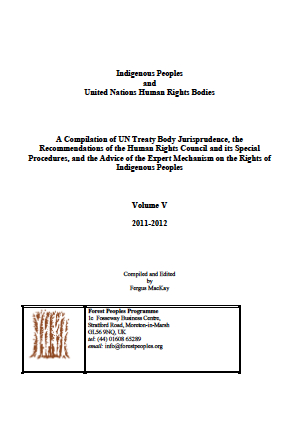
In the rapidly changing field of international Indigenous rights, it can be difficult to track new developments. To address this gap, the Forest Peoples Programme has been monitoring all developments around the rights of Indigenous peoples in UN human rights bodies in a series entitled “A Compilation of UN Treaty Body Jurisprudence, the Recommendations of the Human Rights Council and its Special Procedures, and the Advice of the Expert Mechanism on the Rights of Indigenous Peoples.” They recently released the 5th volume in this compilation, which covers the jurisprudence of UN human rights bodies pertaining to Indigenous peoples from 2011-2012 and was compiled and edited by Fergus MacKay. 

The publication can be accessed here. For further information, see the volumes from 2009-2010, 2007-2008, 2005-2006 and 1993-2004.

Friday, January 11, 2013

Global Indigenous Movement in 2012

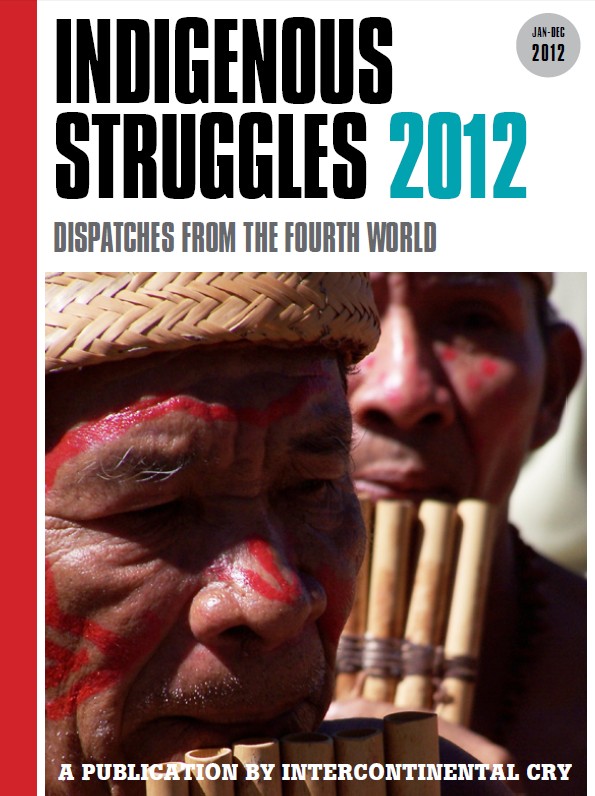
Intercontinental Cry, an independent, volunteer-run magazine dedicated to Indigenous Peoples, has released “Indigenous Struggles 2012: Dispatches from the Fourth World.” The report, which is described as an annual briefing on the global Indigenous movement, is based on Intercontinental Cry’s monthly “Underreported Struggles” reports. 

The introduction marks the monumental advances made by the global Indigenous movement in 2012, noting “the Nasa’s expulsion of military personnel from their territory in Colombia, the group of villagers in India who enforced the destruction of Monsanto test crops, a dozen solid victories against the tar sands and associated pipelines, and let’s not forget the sudden appearance of #idlenomore in Canada and the equally sudden establishment of new Indigenous governments in Nigeria, Australia and West Papua.” It also notes some of the challenges and tragedies of 2012. 

The introduction can be accessed here. The full report can be downloaded directly here. Follow Intercontinental Cry on Twitter here and like them on Facebook here

Tuesday, December 11, 2012

Panel on COP 18 and Indigenous Peoples' Rights


Via the Asia Indigenous Peoples Pact (AIPP), a recent panel offered representatives from Indigenous rights organisations a platform to share their analysis of the climate change negotiations on 4 December 2012 in Doha, Qatar, during the UN Framework Convention on Climate Change’s 18th conference of parties (COP 18). The panel was organised by Tebtebba and the Indigenous Peoples’ Partnership on Climate Change and Forests and panelists included Victoria Tauli-Corpuz (Tebtebba), Dennis Mairena (Centro para la Autonomia y Desarollo de los Pueblos Indigenas - Nicaragua), and Stanley Kimaren (Indigenous Livelihoods Enhancement Partners - Kenya). 

The panelists analysed texts from the Subsidiary Body on Implementation and the Subsidiary Body on Scientific and Technological Advice and noted the extremely slow pace in negotiations in the Long Term Cooperative Action and Kyoto Protocol working groups. They also discussed the importance in protecting gains made by Indigenous peoples in the next climate change agreement, including the recognition of the UN Declaration on the Rights of Indigenous Peoples, recognition of the traditional knowledge of Indigenous peoples, and the requirements for full and effective participation in climate change programmes. On the Green Climate Fund, the panelists called for full and effective participation of Indigenous peoples, with separate representation from civil society.

Also relevant to climate change negotiations, Simone Lovera (Global Forest Coalition) recently drafted an article, posted on REDD-Monitor, on how the form of Measuring, Reporting and Verification (MRV) systems being developed to track the Reducing Emissions from Deforestation and Forest Degradation (REDD+) programme may be a ‘trojan horse’ for carbon markets that have yet to demonstrate results. 

Video from the panel can be accessed here. Simone Lovera’s article can be found here.

Friday, November 30, 2012

Important Publications on REDD+ for COP 18

As government representatives gather to consider solutions to, and means to mitigate the impact of, climate change at the 18th Conference of Parties of the United Nations Framework Convention on Climate Change, several significant publications on the impact of climate change and Reducing Emissions from Deforestation and Forest Degradation (REDD+) on the rights of Indigenous peoples have been launched by Natural Justice partners. 

The Asia Indigenous Peoples Pact (AIPP) and the International Work Group for Indigenous Affairs (IWGIA) have published a briefing paper entitled "REDD+, Rights and Indigenous Peoples: Lessons from REDD+ Initiatives in Asia." The brief examines how far countries participating in REDD+ in Asia have advanced in addressing the social and environmental safeguards needed for the implementation of REDD+ and reflects on pilot activities in Nepal, Cambodia and Vietnam. Their findings suggest that outstanding critical issues for Indigenous peoples include the lack of effective engagement, free, prior and informed consent, and unresolved land tenure and carbon rights issues. The brief can be downloaded here.  

The Forest Peoples Programme, has released a note that refers to the Indigenous Peoples Caucus position on REDD+ and analyses key issues and opportunities for Indigenous peoples to influence the current REDD+ negotiations in Doha. The note can be downloaded here

The Indigenous Peoples Caucus, on behalf of the International Indigenous Peoples Forum on Climate Change (IIPFCC), released a statement to the Subsidiary Body for Scientific and Technical Advice (SBSTA) concerning REDD+ which raised issues such as the need to respect collective and customary systems of forest governance and management, the roles and contributions of Indigenous women, and the need for an independent complaints mechanism. The statement can be accessed here.

Wednesday, November 28, 2012

AIPP Report on Indigenous Peoples and Climate Change Adaptation

Climate change is increasingly impacting the livelihoods and wellbeing of Indigenous peoples through erratic rainfall, unpredictable climatic patterns, flooding, and increased water and food security. To explore these challenges, consider the ways that Indigenous peoples are responding to them and identify policy options to support Indigenous peoples' climate change adaptation, the Asia Indigenous Peoples Pact (AIPP) has released a report entitled “Indigenous Peoples and Climate Change Adaptation in Asia.” 

The report reviews two case studies on Indigenous adaptation practices. The first, a survey of the Tangkhul Naga of northeast India, notes the significant impact of climate change in the community, including shifts in species of birds, reduced frost in October, increased pests and weeds, and shifting rain patterns. In response, the Tangkhul Naga have adjusted their agricultural practices to emphasise un-burnt shifting cultivation over rain-fed terrace paddies. The report also considers the adaptation practices of the Pidlisan-Kankanaey community of the Philippines. 

The report then summarises key international frameworks relevant to climate change adaptation. It concludes with policy recommendations on Indigenous peoples and climate change adaption, urging greater recognition of Indigenous peoples’ traditional knowledge and community-based adaptation strategies, increased recognition of Indigenous peoples’ rights, ensuring free, prior and informed consent in all mitigation and adaptation programmes, and providing sustainable livelihood diversification support to communities. 

“Indigenous Peoples and Climate Change Adaptation in Asia” can be downloaded here.

Saturday, November 24, 2012

Fellowship Opportunity at IACHR

Natural Justice strongly encourages partners to consider applying for a recently opened fellowship on Indigenous peoples' rights with the Executive Secretariat of the Inter-American Commission on Human Rights (IACHR) of the Organisation of American States (OAS). The IACHR has been a leading institution for the advancement of Indigenous peoples' rights, and fellows will support the Rapporteurship on the Rights of Indigenous Peoples. The position has been opened to provide an opportunity for young lawyers from OAS Member States to understand and apply the mechanisms of protection of the inter-American system of human rights in the area of Indigenous peoples’ rights. 

Successful applicants must be citizens of an OAS member state, be proficient in Spanish, have received a law degree after January 2005, and have a demonstrable professional interest in the legal field of human rights, specifically in the area of Indigenous peoples’ rights. Applicants must present a paper of up to five pages, not edited by another person, on a human rights issue of interest to the candidate in the area of indigenous peoples’ rights. 

Find out more about the position here.

Friday, November 23, 2012

Article on Unique Rights of Indigenous Peoples - Think Africa Press

Via thinkafricapress.com
The body of law and policy around the rights of Indigenous peoples and local communities is changing and expanding rapidly. To offer a brief overview of notable international instruments and cases relevant to the African context, Dinah Shelton of the Inter-American Human Rights Commission has prepared an article on relevant law entitled "The Unique Rights of Indigenous Peoples" for a Think Africa Press online course on ‘International Law and Africa.’ 

The article briefly explains and considers the implications of developments in three areas: the international sphere; African cases; and Inter-American cases. At the international level, ILO Convention No. 107, ILO Convention No. 169, and the UN Declaration on the Rights of Indigenous Peoples are considered. For African cases, the Endorois case at the African Commission on Human and Peoples Rights is covered. On Inter-American cases, the growing jurisprudence around land rights and the right to property, as well as the Awas Tingni judgment of the Inter-American Court, are detailed. 

The article can be accessed here. More information on the Think Africa Press course, which is offered free of charge, can be found here.

Monday, November 19, 2012

Two Opportunities for EMRIP Submissions

Via www.ohchr.org
Two significant opportunities are available to contribute to the Expert Mechanism on the Rights of Indigenous Peoples' (EMRIP) work to develop and monitor the implementation of law and policy around Indigenous people’s rights. The first is a survey for Indigenous peoples on strategies for implementing the United Nations Declaration on the Rights of Indigenous Peoples (UNDRIP). The survey can be completed online here and should be submitted by 18 February, 2013. 

The second is an opening for contributions by Indigenous peoples, academia, national human rights institutions, civil society and other interested groups and persons  on EMRIP's study on access to justice in the promotion and protection of Indigenous peoples’ rights. There is no prescribed form for submissions, and contributions should submitted via email to expertmechanism@ohchr.org by 11 Febrary, 2013.

Saturday, November 17, 2012

1st Africa Land Forum - Yaoundé Declaration

In recent years, the demand for productive land has surged as a result of global food and financial crises, as well as increasing concerns about energy security. In many countries, carbon sequestration as a response to climate change has also contributed to land pressure. This has rendered land an increasingly disputed and commoditised resource, compromising rural people’s access to, and control over, land. Indigenous communities have been particularly vulnerable to these pressures as many in Africa are pastoralists and hunter-gatherers and the land they occupy and depend on for their livelihoods is often perceived as empty. 

In this context, the First Africa Land Forum, themed “Securing the land rights of indigenous people and rural communities,” was held in Yaoundé, Cameroon from 7-8 November, 2012. The forum was organised by the Africa Platform of the International Land Coalition (ILC) and hosted by the Mbororo Social and Cultural Development Association (MBOSCUDA). Over 95 participants from 22 countries, representing indigenous and non-indigenous organisations, attended. The forum culminated in the drafting and signing of the Yaoundé Declaration.