Showing posts with label LAPSSET. Show all posts

Tuesday, December 23, 2014

Supporting and Strengthening Communities in Marsabit County, Kenya


Aside from being one of the rockiest parts of East Africa, Marsabit County is the second largest county in Kenya, covering at least 15% of the country’s entire territory. Straddling along the boundary between Kenya and her northern neighbor Ethiopia, this county has over 14 different ethnic groups who call it home with sundry livelihoods: including pastoralists, fishermen, hunter-gatherers and small-scale agriculturalists. This large pocket of Kenya also embodies a most diverse landscape, from the ever foggy and freezing highlands formed from historically volcanic mountains near Marsabit Town to a much warmer low lying rugged terrain spanning thousands of square kilometers, and the world’s largest desert lake – the threatened UNESCO World Heritage Site, Lake Turkana.

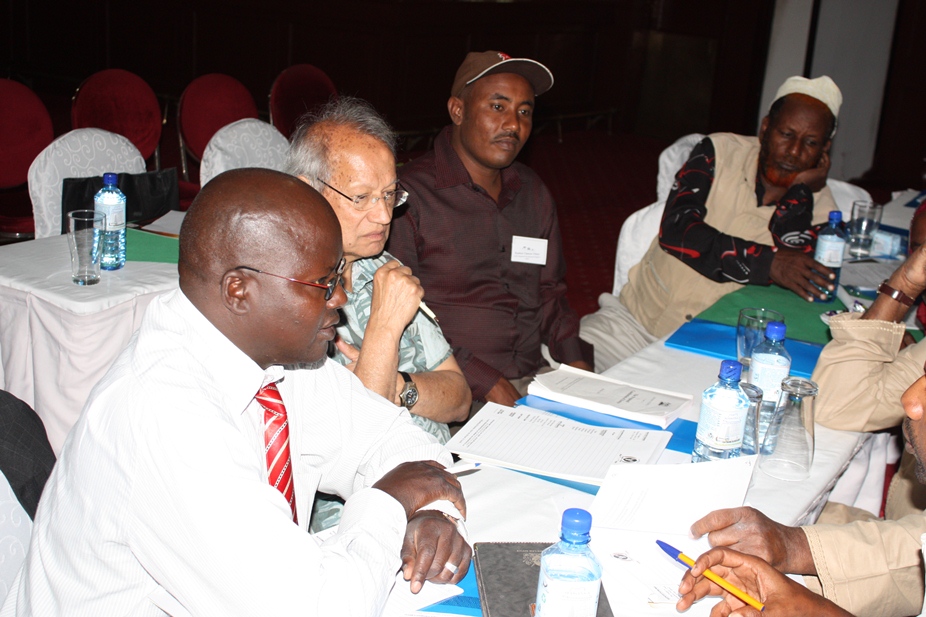
From the 4th to the 11th of December, Shalom Ndiku and Achieng Orero, of Natural Justice’s Kenya office, partook in the Kalacha Cultural Food and Music Festival 2014 hosted by the Kivulini Trust. In addition to that, they also facilitated a Regional Workshop for the LAPSSET Community Forum (LCF) communities in Marsabit County through the able assistance of Golbo Integrated and the Heinrich Boll Foundation East and Horn of Africa’s Office.

Monday, November 24, 2014

LAPSSET Community Forum Holds 'People’s Dialogue on LAPSSET

Energy. Transportation. Trade. These are the economic drivers that the Kenyan government is seeking to tap at scale as it attempts to meet the goals in its "Vision 2030" plan for turning Kenya into a middle-income country. Central to this plan is an infrastructure corridor known as LAPSSET, which stands for "Lamu Port, South Sudan, Ethiopia Transport."  But there is another element that needs to be considered in infrastructure development: people.

To ensure that that happens, a coalition of civil society organizations have joined together to form the LAPSSET Community Forum (LCF) in order to examine the potential benefits and impacts of the LAPSSET corridor on affected communities and respond to those benefits and impacts in an organized manner. On 24 November 2014, the LCF kicked off a four day meeting in Lamu to discuss issues related to LAPSSET and strategize on a way forward. The meeting brings together stakeholders located all along the LAPSSET corridor, from northern Kenya to those in Lamu itself.

If LAPSSET is completed as planned, many parts of Kenya that have seen little development since decolonization, such as the northern part of the country and the northern coast, will experience profound changes in existing infrastructure. New infrastructure will include paved roads, railways, airports, and even entire cities. Such infrastructure will bring new economic opportunities, but it will also cause major environmental and social impacts. The LCF seeks to understand these impacts and ensure that community rights, particularly those relating to land and livelihoods, are taken into account in the planning and implementation of LAPSSET.

Monday, October 27, 2014

Natural Justice Attends Workshop on Community Land Rights in Kenya

On October 15th and 16th, the Natural Justice Kenya team attended a Community Land Protection workshop in Nairobi, which was facilitated by OXFAM, the Kenya Land Alliance (KLA) and Namati.  Natural Justice is continuing its collaboration with Namati following the successful meeting held in November, 2013 with African community rights activists on community land and natural resource rights.

The primary objective of the two-day workshop was to present Namati’s community land protection process and to discuss the Community Land Bill. The workshop was attended by a number of Kenya civil society organizations and indigenous peoples networks, including Natural Justice’s community partners Kivulini Trust, Friends of Lake Turkana and Save Lamu. In 2013, Natural Justice partnered with Namati to host a meeting.

Friday, October 17, 2014

BCP Training with County Government and Community Members of Isiolo, Kenya

Anab Kassim – Chairlady – Young Mothers Isiolo
On October 8, 2014 Natural Justice partner, Kivulini Trust, held a meeting on the application of bio-cultural community protocols (BCP). The workshop brought together representatives from County Government of Isiolo and Community members developing BCPs.

County Government representatives and community members are increasingly concerned that the Lamu Port – Southern Sudan- Ethiopia Transport (LAPSSET) Corridor will exacerbate the existing economic and cultural marginalization, persistent state of insecurity and lack of secure land tenure.

Sunday, November 24, 2013

Coexistence of Culture, Environment & LAPSSET Theatre Performance

Save Lamu information booth at the Cultural Festival
On Saturday 21st November, Save Lamu Voices gave a theatre performance, entitled Coexistence of Culture, Environment & LAPSSET at the 13th Annual Lamu Cultural Festival. The workshops and performance were organized by one of Natural Justice’s partners, Save Lamu

The group Save Lamu Voices is a group of local actors, consisting of youth, women, and members of indigenous communities within the county such as the Bajun, Orma, Aweer and Sanye. The performance was the result of several weeks of participatory theatre workshops aiming to: 
  1. Raise awareness amongst the community on the LAPSSET Project and extractives industries in Lamu; 
  2. Foster dialogue amongst the community on dealing with the challenges of the impending port, including the preservation of the cultural and social identity of marginalized indigenous communities in Lamu. 

Sunday, October 6, 2013

Save Lamu Forum on Human and Environmental Rights Monitoring

On Saturday October 5th Steph Booker and Maya Sikand from Natural Justice presented at a Forum hosted by Save Lamu on Human and Environmental Rights Monitoring in Lamu Town. Participants of the meeting included members of the Lamu community from the Islands and Mainland as well as representatives from communities along the LAPSSET corridor. 

Natural Justice gave a presentation on 'What is Human and Environmental Rights Monitoring?'. Participants then separated into groups according to region, and began documenting changes they have witnessed in their areas. This was an important first step in collecting information, and understanding what sort of questions are asked during human rights monitoring. It is hoped that this forum is the beginning of a wider effort at human rights monitoring training for community organisations along the LAPSSET corridor. Such documentation is an important tool when making a case about human or environmental rights abuses against companies or the government.

Presentations were also made by Sarah Singh from Accountability Counsel and Mohammed Ramadhan from the Kenyan National Commission on Human Rights on national and international grievance mechanisms. Save Lamu have initiated creative ways to bring all the information about changes in the communities to one central place, for example through text messages.

Friday, September 27, 2013

Indigenous Pollinators: Honey and Harmony

From the 25-26th of September one of Natural Justice’s partner organizations in Kenya, Kivulini Trust co-hosted an Indigenous Pollinators Network Workshop in Nairobi, together with the FAO and Indigenous Partnership for Agrobiodiversity and Food Sovereignty.

The objective of the workshop was to establish a network of indigenous communities knowledgeable of and supportive towards pollinators. A similar workshop was held last month in India, where an Indigenous Pollinators Network has been formed. Through such a network communities can share best practices and provide support to each other. Another goal of the workshop was to create awareness of the many different pollinators that exist, and their importance.
What is a pollinator?
The workshop commenced with a presentation by pollination expert Dr. Mary Gikungu from the National Museums of Kenya on what is a pollinator? Most of us think only of bees – and honeybees at that – when we hear the word pollinator. In fact, honeybees account for only a tiny fraction of the pollinators that exist – there are many other species of bees, as well as birds, butterflies, bats and other insects that provide the world with essential pollination services. In case it has been a while since you took a biology class – pollinators are important because without them most plants would not be able to reproduce – which would mean no food, or other plant materials, so important for humans and the environment.

Saturday, February 16, 2013

LAPSSET Dialogue Meeting in Nairobi

On 15 February 2013, Gino Cocchiaro (Natural Justice) attended a stakeholder dialogue meeting on the on-going plans and sharing of updates on the implementation of the Lamu Port and Lamu Southern Sudan-Ethiopia Transport Corridor (LAPSSET) in Nairobi, Kenya. The meeting was facilitated by Save Lamu and included over 50 participants from communities affected by LAPSSET, national civil society organisations, multinational organisations and Kenyan government agencies. The meeting resulted in the drafting and adoption of a statement on the aspirations and concerns of communities affected by LAPSSET projects. 

From the statement, “As communities that have long been disenfranchised, and that are in dire need of development, we commend the Kenyan government for its commitment to upgrading and modernising the country’s infrastructure as per the proposed Lamu Port, South-Sudan, Ethiopia Transport (LAPSSET) Corridor outlined in the Government of Kenya’s 'Vision 2030'. We appreciate the need for connecting communities along the northern corridor to facilitate national and international trade. However, we are deeply concerned by the lack of community consultation and transparency in the implementation of the project and hereby wish to express our concerns.” 

Read more about the meeting here. Download the community statement here.