Showing posts with label TK Commons. Show all posts

Friday, March 1, 2013

Panel on TK Documentation, Valorisation and Compliance

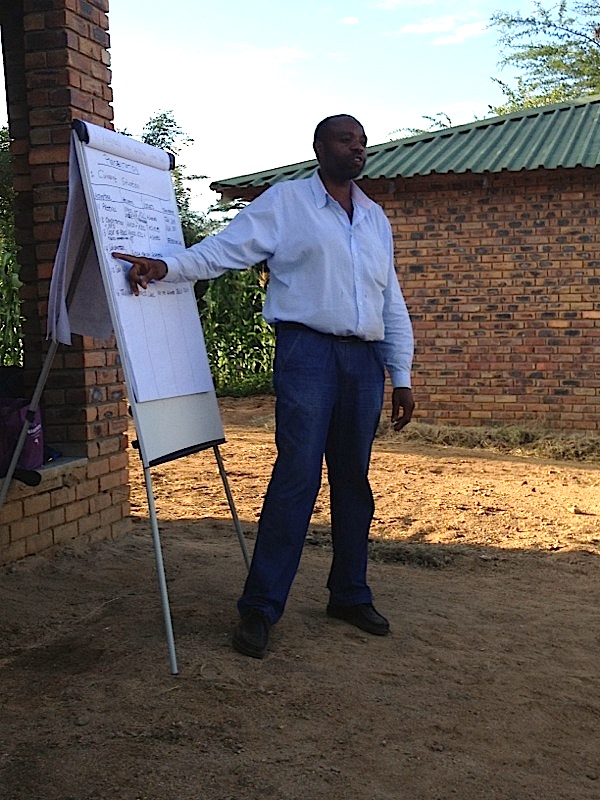
On 27 February 2013, Gino Cocchiaro (Natural Justice) and Rodney Sibuyi (Kukula Traditional Health Practitioners Association) participated in a panel discussion together with Tom Suchanandan (South African Department of Science and Technology - DST) and Lazarus Kairabeb (Nama Traditional Leaders Association, Namibia). The panel was moderated by Barbara Lassen (ABS Initiative) and dialogue and questions followed brief presentations by panelists. The panel was held as part of the seventh Pan-African Access and Benefit Sharing (ABS) Workshop hosted by South Africa’s Department of Environmental Affairs from 25 February to 1 March 2013 in Phalaborwa, South Africa.

Gino presented on “A Traditional Knowledge Commons.” He began by identifying challenges, how knowledge sharing happened before ‘modernisation’, and suggested potential new models for sharing traditional knowledge. He discussed how knowledge can be seen as a relationship between the ancestors, the group of traditional healers, and individual experiences. He further explained how the use of a biocultural community protocol (BCP) by Kukula helped to create and preserve a pool of knowledge. Mr Sibuyi also emphasised the challenges faced by traditional healers and the positive experience with the BCP.

Mr Suchanandan described the South African National Recordal System, an initiative of the DST which will document, record and store Indigenous Knowledge (IK) for the benefit of the communities of South Africa. It takes into consideration the recording of IK in various multimedia formats and aims to promote and conserve community IK. It proposes both positive and defensive protection of IK. The system also aims to collect grassroots community experiences in local languages. 

Mr Kairabeb shared on his experiences during the recent capacity building workshop on the Nagoya Protocol on ABS, Traditional Knowledge and Nagoya – Kuala Lumpur Supplementary Protocol on Liability and Redress of Bio-safety in India.

Tuesday, December 11, 2012

Kukula Healers Review 2012 & Plan for 2013

On 6-7 December 2012, Gino Cocchiaro (Natural Justice) attended a meeting of the Kukula Traditional Health Practitioners Association in Thulamahashe, South Africa. The Kukula Traditional Health Practitioners, a group of over 300 traditional health practitioners who developed a biocultural community protocol (BCP) in 2009, were meeting to discuss and evaluate their activities completed in 2012 as well as highlighting their aims for 2013. 

Accomplishments from 2012 included: registering as a NPO in South Africa; drafting a code of ethics for all members of the Kukula Association; creating a traditional knowledge common pool where individual knowledge is shared amongst members and with a local cosmetics company interested in the research and development of the knowledge; and collaborating with  Kruger National Park in its anti-rhino poaching efforts. In 2013, Kukula members plan to update their BCP to reflect legal developments and new priorities, to continue to develop their relationship with the cosmetics company towards and access and benefit sharing agreement, to continue to work for formal recognition as traditional health practitioners, to distribute copies of the code of ethics to all members, and to continue to support anti-poaching efforts.  The Kukula Association are also members of the African BCP Initiative and will continue to to seek the protection and growth of their knowledge, culture and the conservation of biodiversity in their area. 

Download the Kukula BCP here

Thursday, November 22, 2012

New Article on Ostrom's Impact on American Legal Academy

Via www.thecommonsjournal.org
A new article has been released by the International Journal of the Commons on the impact of Elinor Ostrom’s work on the commons in the United States. The article, entitled “Ostrom and the lawyers: the impact of Governing the Commons on the American legal academy,” is authored by Carol M. Rose of Yale Law School and the University of Arizona Law College. The article traces the periods where Ms Ostrom’s signature work, “Governing the Commons”, was cited most often and the subject areas in which it was cited most frequently. 

The article identifies three areas where "Governing the Commons" had the greatest impact: general property theory, environmental and natural resource law, and intellectual property. In these areas legal scholars found "Governing the Commons" to “support the proposition that people can cooperate to overcome common pool resource issues, managing resources through informal norms rather than either individual property or coercive government.” The article also finds that some legal academics have been critical of some of GC’s findings, and many sought to balance GC’s themes of stability and sustainability with more ‘standard’ legal models supporting open markets, fluid change and egalitarianism. 

The article can be accessed at the International Journal of the Commons website here.

Friday, February 3, 2012

TK Commons Meeting in Cape Town

On the 31st January representatives from the Bushbuckridge Traditional Healers’ Association, lawyers working on issues around traditional knowledge (TK) from Kenya and Ghana, and Natural Justice gathered in Cape Town with support from the Open A.I.R. Project. The theme was “Non-Traditional Users of TK—Opportunities and Challenges Around Compliance”. Breakout sessions delved into the definition of TK commons, methods of pooling and sharing TK, TK practioners and their issues, external links to non-traditional users of TK, and existing and future policies around TK. Interviews with the healers from Bushbuckridge on the challenges they have faced in managing the sharing of their TK informed much of the discussion. 

Looking forward, the representatives looked to build on the successes of the Bushbuckridge community. As communities in Ghana and Kenya move forward with their development of TK commons, participants will support the development of linkages between these communities and the Bushbuckridge healers. They will also continue to look for ways to creatively collaborate to analyse and shape laws and policies around TK based on experiences at the grassroots level.

Saturday, September 17, 2011

International Workshop on Common Pools

On the 15th and 16th of September, Gino Cocchiaro (Natural Justice) attended the "International Workshop on Common Pools of Genetic Resources: improving effectiveness, justice and public research in access and benefit sharing (ABS)" in Bremen, Germany, organized by the University of Bremen. The workshop was attended by various experts in the areas of genetic resources, traditional knowledge, and benefit sharing. Over the 2 days, participants presented on a range of subjects on common pools, including exploring legal spaces for common pools in the Nagoya Protocol; case studies on existing common pools at the local level in South Africa, Brazil, Peru and China; the World Health Organization (WHO) frameworks for sharing vaccines; the multilateral system of the International Treaty on Plant and Genetic Resources for Food and Agriculture (ITPGRFA); and data banks for genetic information and marine organisms. The presentations and discussions provided participants relevant feedback and information about how existing common pools systems are functioning and could be improved to ensure greater equity and fairness.

Natural Justice was asked to present on the traditional knowledge common pool of the traditional health practitioners of Bushbuckridge, South Africa, and the development of a common pool of traditional knowledge. The healers are utilizing their common pool to provide information to a local cosmetics company, with any benefits from research and possible development to flow back into the collective pool. The presenters at the workshop will also be contributing chapters to a book on common pools to be published by the University of Bremen.